

What is the spray angle of a rotary air spray gun?
Hey there! If you're in the market for a rotary air spray gun, you've probably got some questions. One of the most common - and important - ones is: "What is the spray angle of a rotary air spray gun?" Well, you've come to the right place! As a supplier of top-notch rotary air spray guns, I'm here to break it all down for you.
First things first, let's talk about what the spray angle actually means. The spray angle of a rotary air spray gun refers to the width of the cone-shaped spray pattern that the gun produces. Think of it like a fan being opened up - a wide fan has a large angle, while a narrow fan has a small one. In the context of a spray gun, this angle determines how much surface area you can cover in one pass.
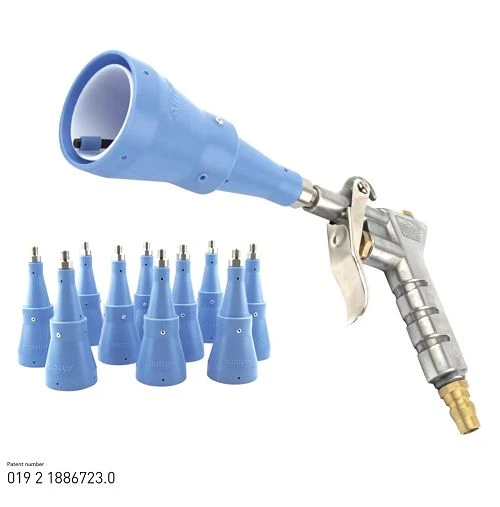
There are different factors that can affect the spray angle of a rotary air spray gun. One of the main ones is the design of the nozzle. Nozzles come in a variety of shapes and sizes, each engineered to produce a specific spray angle. For example, a 50mm Air Spray Gun Nozzle Air Compressor is designed with a particular geometry that will result in a unique spray pattern. The internal channels and orifices within the nozzle play a crucial role in shaping the spray and determining its angle.
Another factor is the air pressure. If you crank up the air pressure, the spray angle can widen. This is because the higher pressure forces the liquid or material being sprayed out more forcefully, causing it to disperse over a wider area. On the flip side, if you lower the air pressure, the spray angle will narrow. It's a delicate balance, and finding the right air pressure for your specific application is key.
The viscosity of the material you're spraying also matters. Thicker materials tend to have a narrower spray angle. Think about trying to spray honey compared to water. Honey is much thicker and more viscous, so it won't spread out as easily as water. When using a rotary air spray gun, you might need to adjust the settings or the nozzle to get the right spray angle for a thick liquid.
So, what are the common spray angles for rotary air spray guns? Well, it can vary widely depending on the type of gun and its intended use. For general-purpose spraying, angles can range from as narrow as 15 degrees to as wide as 75 degrees or more. A narrow spray angle, say around 15 - 20 degrees, is great for precision work. If you're doing detailed painting on a small object, like a model car or a piece of jewelry, a narrow angle will let you control the spray and apply a fine, focused coat.
On the other hand, a wide spray angle, around 60 - 75 degrees or more, is ideal for covering large areas quickly. If you're painting the side of a house or the body of a large vehicle, a wide spray pattern will let you get the job done in fewer passes. It's all about matching the spray angle to the task at hand.
Let's take a look at some real-world examples of how the spray angle affects different applications. In the automotive industry, body shops often use rotary air spray guns with various spray angles. When applying a base coat or a primer, they might opt for a wider spray angle to cover the large surface area of the car body efficiently. But when it comes to applying a clear coat or doing some touch-up work around specific parts, a narrower spray angle will be used for more precision.
In the woodworking industry, a wide spray angle can be used for quickly applying stains or finishes to large wooden panels. However, if you're working on a carved piece of furniture where intricate details need to be coated, a narrow spray angle will be the way to go.
As a supplier, I've seen firsthand how important it is to choose the right spray angle. That's why our rotary air spray guns come with a variety of nozzle options to ensure you can achieve the perfect spray pattern for your needs. We understand that different customers have different requirements, whether you're a professional painter, a DIY enthusiast, or an industrial manufacturer.
Now, you might be wondering how to test and adjust the spray angle. Well, it's not as complicated as it sounds. Most modern rotary air spray guns have adjustable air caps that allow you to change the spray pattern. You can start by doing a test spray on a scrap piece of material. Observe the spray pattern and see if it's too wide, too narrow, or just right. If you need to adjust, simply turn the air cap or make the necessary changes to the air pressure settings.
It's also a good idea to keep in mind the distance between the spray gun and the surface being sprayed. The further away you hold the gun, the more the spray will disperse, effectively widening the spray angle. So, pay attention to this distance as well. A general rule of thumb is to keep the gun at a consistent distance of around 6 - 8 inches from the surface for most applications.
In conclusion, understanding the spray angle of a rotary air spray gun is crucial for getting the best results in your spraying projects. Whether you're looking for precision or speed, there's a spray angle that's right for you. And as a supplier, I'm here to help you find the perfect combination of gun, nozzle, and settings.
If you're interested in learning more about our rotary air spray guns or have questions about which spray angle would be best for your specific application, don't hesitate to get in touch. We'd love to have a chat and guide you through the process. Let's make your spraying projects a success!
References

- Industrial Painting and Coating Handbook
- Automotive Finishing Techniques: A Practical Guide
- Woodworking Finishing Best Practices