

What are the differences between a high speed centrifugal blower and a positive displacement blower?
What are the differences between a high speed centrifugal blower and a positive displacement blower?
In the realm of industrial air - moving equipment, high speed centrifugal blowers and positive displacement blowers are two commonly used types. As a supplier of high speed centrifugal blowers, I am well - versed in the characteristics of both and can clearly delineate their differences.
Working Principle
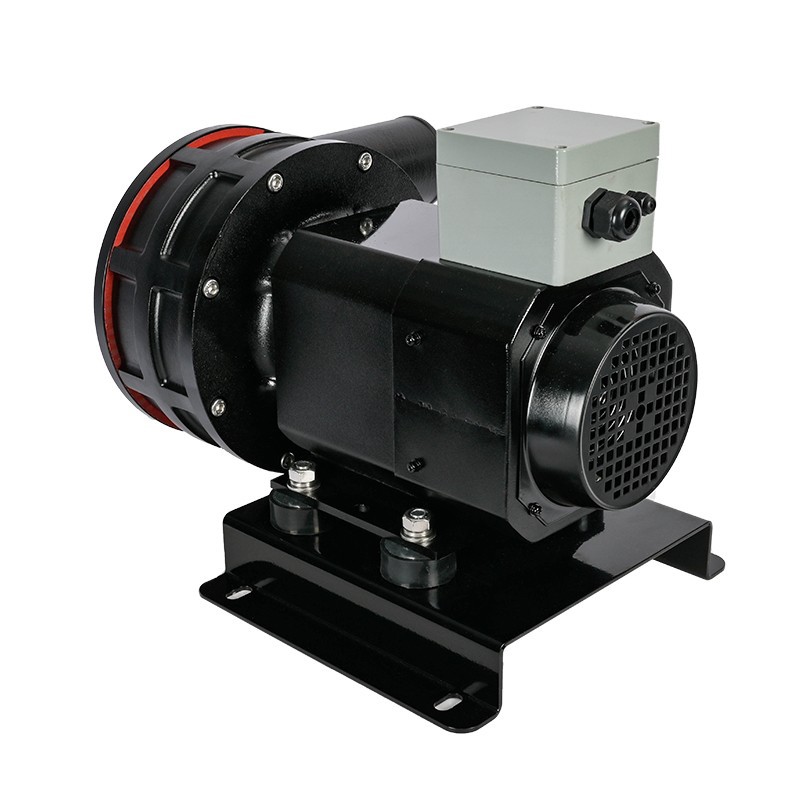
A high speed centrifugal blower operates based on the principle of centrifugal force. It has an impeller that rotates at a very high speed. When the air enters the center of the impeller, the high - speed rotation of the impeller imparts kinetic energy to the air. The air is then forced outwards from the impeller's periphery at a high velocity. Subsequently, the kinetic energy of the air is converted into pressure energy as it passes through the volute casing of the blower. For instance, in a Drying Blower for Ultrasonic CleanerDPT - 150, the high - speed rotation of the impeller ensures efficient air movement and pressure generation for the drying process.
On the other hand, a positive displacement blower works by trapping a fixed volume of air and then displacing it into the discharge system. There are different types of positive displacement blowers, such as rotary lobe blowers and screw blowers. In a rotary lobe blower, two lobed rotors rotate in opposite directions within a casing. As the rotors turn, they trap air in the cavities between the lobes and the casing and push it towards the discharge port. The volume of air displaced per revolution is constant, regardless of the discharge pressure (within the blower's design limits).
Pressure and Flow Characteristics
High speed centrifugal blowers are known for their ability to provide high - flow rates at relatively low to medium pressures. They can handle large volumes of air efficiently. For example, the AIIHANK High - Speed Turbine Three - Dimensional Flow Blower DPT - 100 is designed to offer high - volume air flow, which is suitable for applications like large - scale ventilation systems in factories. The flow rate of a centrifugal blower can be easily adjusted by changing the speed of the impeller through a variable frequency drive (VFD). However, as the discharge pressure increases, the flow rate may decrease due to the limitations of the centrifugal force and the design of the blower.
Positive displacement blowers, in contrast, are capable of generating relatively high pressures at a relatively constant flow rate. They are less sensitive to changes in the discharge pressure compared to centrifugal blowers. This makes them ideal for applications where a consistent flow rate is required, even when the system pressure varies. For example, in pneumatic conveying systems, positive displacement blowers can maintain a stable air flow to ensure the proper movement of materials through the pipes.
Efficiency
The efficiency of high speed centrifugal blowers is often higher at their design operating points. When the blower is operating at the flow rate and pressure for which it is designed, it can convert a large proportion of the input power into useful air movement. However, if the operating conditions deviate significantly from the design point, the efficiency may drop. For example, if a centrifugal blower is forced to operate at a much lower flow rate than its design value, the impeller may experience flow separation, which leads to increased energy losses.

Positive displacement blowers generally have a more consistent efficiency over a wider range of operating pressures. Since they displace a fixed volume of air per revolution, the efficiency is not as strongly affected by changes in pressure as centrifugal blowers. However, positive displacement blowers may consume more energy at low - pressure, high - flow applications compared to centrifugal blowers.
Noise and Vibration
High speed centrifugal blowers tend to produce less noise and vibration compared to positive displacement blowers. The smooth rotation of the impeller in a centrifugal blower results in a relatively quiet operation. Additionally, modern centrifugal blowers are often equipped with noise - reducing features such as acoustic enclosures and aerodynamically designed impellers. For example, the DPT - 85 编号37 is designed with noise - reduction in mind, making it suitable for use in environments where noise levels need to be kept low, such as hospitals or research laboratories.
Positive displacement blowers, due to the nature of their operation, can generate significant noise and vibration. The rapid trapping and displacement of air, as well as the mechanical interaction between the rotors, can cause vibrations and loud noise. Special vibration - isolation mounts and noise - suppression equipment are often required to reduce the noise and vibration levels in positive displacement blowers.
Maintenance
High speed centrifugal blowers typically have fewer moving parts compared to positive displacement blowers. The main components of a centrifugal blower are the impeller, motor, and bearings. Regular maintenance mainly involves checking the bearing lubrication, inspecting the impeller for damage, and cleaning the air intake filters. This relatively simple maintenance requirement reduces the downtime and maintenance costs associated with centrifugal blowers.
Positive displacement blowers have more complex internal components, such as the rotors and the timing gears. The clearances between the rotors and the casing need to be carefully maintained to ensure proper operation. Additionally, the lubrication system of positive displacement blowers requires regular attention to prevent wear and tear of the moving parts. This makes the maintenance of positive displacement blowers more time - consuming and costly.
Application Areas
High speed centrifugal blowers are widely used in applications where high - volume air flow and relatively low to medium pressures are required. Some common applications include ventilation systems, air cooling in industrial processes, and drying operations. For example, in the food industry, high speed centrifugal blowers are used to dry food products after washing or processing.
Positive displacement blowers are commonly used in applications that demand high - pressure air at a constant flow rate. They are used in pneumatic conveying systems, wastewater treatment plants for aeration, and in some industrial processes where a consistent air supply is crucial.
In conclusion, the choice between a high speed centrifugal blower and a positive displacement blower depends on the specific requirements of the application. If you are looking for high - volume air flow at relatively low pressures, with lower noise and easier maintenance, a high speed centrifugal blower like the ones we supply may be the best choice. On the other hand, if you need a consistent flow rate at high pressures, a positive displacement blower might be more suitable.
If you are interested in learning more about our high speed centrifugal blowers or have specific requirements for your application, please feel free to contact us for a detailed consultation and procurement discussion.
References
- Shapiro, A. H. (1953). The Dynamics and Thermodynamics of Compressible Fluid Flow. John Wiley & Sons.
- Bloch, H. P., & Geitner, F. K. (2006). Pump User's Handbook: Life - Extension. McGraw - Hill.
- Karassik, I. J., Messina, J. P., Cooper, P. T., & Heald, C. C. (2008). Pump Handbook. McGraw - Hill.